Exploring the art of Hang Dong: A student spotlight
Updated: Feb 19
Barnard’s campus is home to many student artists, each with their own creative voice to share. I interviewed Hang Dong (BC ’28), a versatile artist seeking to capture treasured moments of serenity, cultivating inclusion while embracing all forms of expression.

Photo provided by Hang Dong
By Nura Ali
February 15, 2026
Amid the chaos of college life, one of the people whose work serves to offer a sense of grounding is Hang Dong (BC ’28), an artist who transferred to Barnard this year. Originally from Shanghai, China, Dong works across multiple mediums, from painting and ceramics to photography. Her workspace on the fourth floor of Diana is filled with paintings in various stages of completion.

Photo provided by Hang Dong
An unexpected beginning
One day in 2020, while the pandemic was unfolding, Dong’s friend dragged her to a painting class in Shanghai, where Dong learned to imitate the style of a painting by French impressionist painter Claude Monet. Even though she had painted before, this time felt different. “I thought, this is so relaxing,” Dong described. Dong decided to continue painting after that class, producing over a dozen pieces in that year alone. It was in the chaotic and uncertain year of 2020, during the COVID-19 pandemic, that Dong found the moment and peace to pursue painting as her primary artistic medium.
Growing up with art
Dong grew up surrounded by art in Shanghai, a metropolitan city with the economic resources to support a thriving art scene, frequently visiting museums and galleries. Yet, despite this immersion in the art world, she never imagined herself as an artist. Among common assumptions that you simply must make art in order to call yourself an artist, Dong’s experience revealed a more complex reality.
“I didn’t think of myself as an artist when I first started to make art,” she explained. This internal barrier, Dong noted, is common. Many people struggle to claim the title of “artist” even as they create. The challenge is not just about choosing between career paths, but about reconciling competing desires in a society that often devalues artistic pursuits. Dong says only upholding these societal expectations is “not going to feed our soul.”
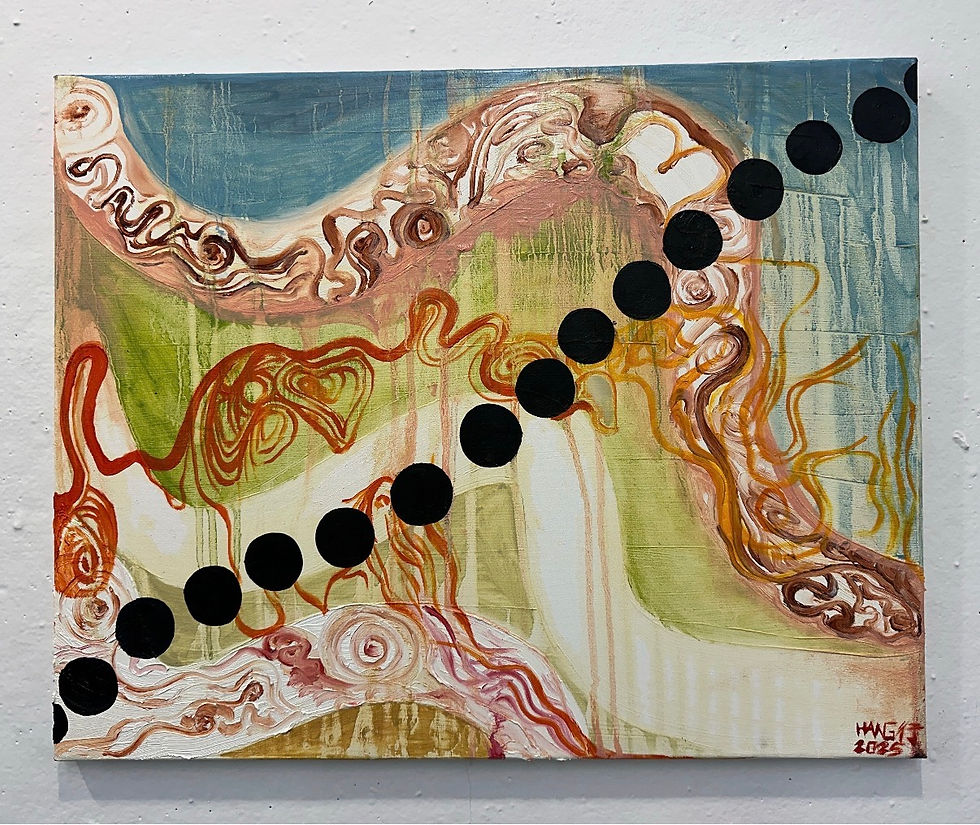
Photo provided by Hang Dong
For Dong, the distinction came down to intention and identity. Was her work real art or simply a passion project? At first, she viewed it as a side hobby, something separate from her identity as a pre-law student. Now, after changing her major to visual arts, she has fully accepted herself as an artist.
Desires, altercation, and finding focus
Dong’s work explores how we position ourselves in the world, a theme she traces back to her admiration for Austrian painter Gustav Klimt. She is particularly drawn to Klimt’s depictions of desire and the way his figures layer and intertwine, representing people grappling with their different needs and wants. This concept of desire as a driving force resonates within Dong’s own paintings.
One of Dong’s pieces captures her friend in a night club, painted from a photograph. In the painting, the friend stands in the center as the focus, surrounded by the chaos of nightlife. The painting is an example of Dong’s signature use of alteration; Dong has elongated the figure’s limbs and heightened the contrast between the friend’s calm presence and the frenzy in the background.

Photo provided by Hang Dong
“You can alter reality in paintings, that’s what makes it different from things like photography,” Dong says. “The body doesn't have to be anatomically correct.” By adjusting proportions and adding or removing elements, she can express emotional truths rather than literal ones in her paintings. In this piece, she wanted to emphasize her friend’s joy despite the simultaneous background frenzy. The painting captures that singular focus.
This approach of alteration extends across Dong’s work. Whether elongating limbs to emphasize vulnerability or stripping away background details to highlight what matters, she uses painting’s malleability to create emotional desire rather than photographic realism.
Community and intention
Since transferring to Barnard, Dong has found herself energized by the artistic community. Being surrounded by students who are equally passionate about art, even while majoring in other disciplines, has validated her own creative practice. “Especially since I know higher education in our country is kind of in a crisis right now,” she noted. “The fact that we can share art together makes it more, more precious.”
Dong is acutely aware of the attacks on communities she is a part of, including the queer community, and the general uncertainty of daily life. Yet, her artistic intention remains clear: “I really do want to continue to express the idea that there is peace in chaos in my art.”

Photo provided by Hang Dong
Moving forward, Dong wants to bring her intentions to fruition by exploring the use of large-scale canvases: “I want to create a sort of immersive visual experience,” where one’s eyes are guided towards observing chaotic feelings through the palette or through symbolism.
Hang Dong’s work is a testament to the power of art as both refuge and resistance. In a world where stability feels increasingly scarce, her paintings offer something vital: a reminder that while acknowledging chaos, we can still find moments of peace and desire worth capturing. More about Dong’s art can be found on her website.