In perfect chord-ination: Columbia University Chinese A Cappella’s spring showcase
Updated: Aug 31
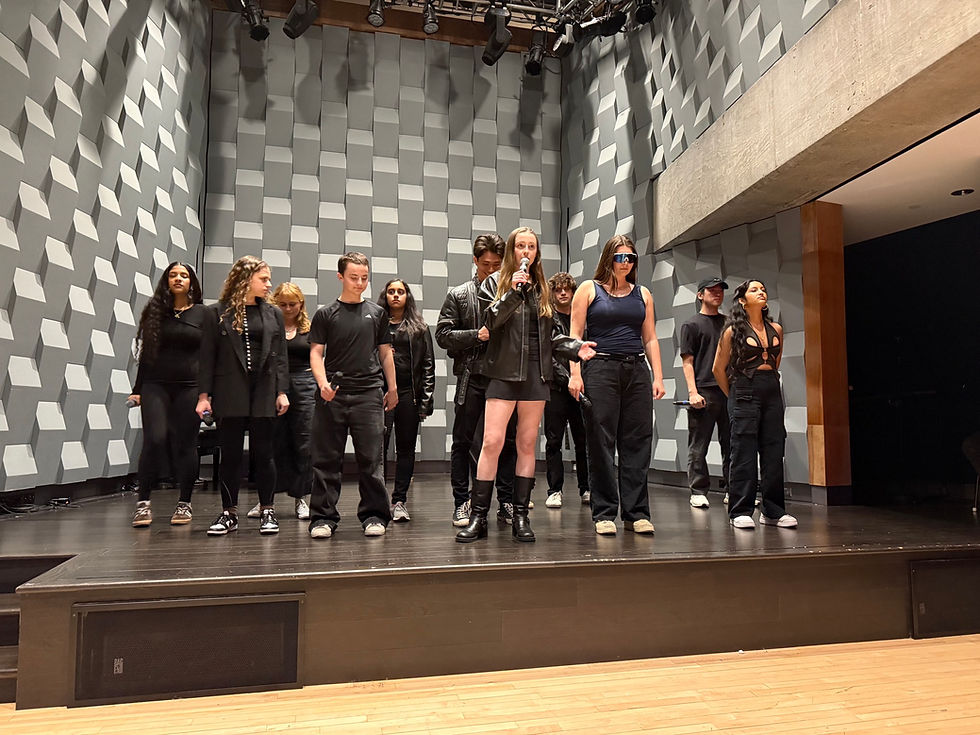
On May 3, Columbia University Chinese A Cappella brought back-to-back performances in Earl Hall Auditorium, blending humor and experimental staging to create an unforgettable a cappella experience.

Photo provided by Columbia University Chinese A Cappella
By Janelle Bai
May 30, 2026
Columbia University Chinese A Cappella’s (CUCAC) spring 2026 showcase transformed Earl Hall Auditorium into a space where music moved dynamically between humorous and heartfelt moments.
Founded in 2023, CUCAC is Columbia University’s newest a cappella group that specializes in “harmonious arrangements of Chinese and international songs.” CUCAC has quickly established itself as a prominent cultural and musical group on campus through performances at the Columbia Night Market, the Columbia Mid-Autumn Festival, and the Langjiu Chinese New Year Gala in the United Nation Diplomats’ dining room.
That artistic ambition came to life once the showcase began. As the lights dimmed, the group embraced an experimental approach that manipulated musical arrangement, staging, props, and production to push beyond conventional a cappella performances. One particularly striking moment was the cinematic rearrangement of “北京北京” / “Beijing Beijing” by third-year PhD student Christina Wang that unexpectedly erupted into a powerful interlude of Jay-Z and Alicia Keys’ “New York Empire State of Mind,” which merged the group’s emphasis on Chinese culture and identity with their lives in New York. Tenor Chunlin An (BC ’25, GSAS ’26) explained that the emotional core of the performance came from a deliberate interpretive choice.
“The inspiration came from those away from their homes in a big city, finding their space,” An explained. “During rehearsals, we emphasized a lot that we have to put ourselves in their shoes, and we literally are in their shoes in many ways — we are in New York, navigating our lives in such a diverse place that sometimes absorbs and completely swallows us.”
In contrast, the group’s rendition of “屋顶” / “Rooftop” by Jay Chou offered a quieter, more intimate moment, featuring a duet with soprano Sophia Peng (CC ’29) and Kexin Yang (GSAS ’26), physically separated with a striking lighting design and overlapping silhouettes against the backdrop.The theatricality was further enhanced by the props — like a boxing glove swapped for a bouquet of flowers — adding a whimsical touch to the performance.
“LIKE THAT” by BABYMONSTER, performed by soprano Jingwen Zhang (SEAS ’25) and alto Eleanor Xie (PH ’27), blended K-pop dance choreography with vocals, bringing a burst of energy to the stage, while a Bruno Mars medley, arranged by bass Jace Li (MS ’26), featured “When I Was Your Man,” “Talking to the Moon,” and “Die with a Smile,” diversifying the setlist through shifts in musical styles.
Other performances leaned into vocal layering. “Die for You” by The Weeknd, arranged by Wang, was dynamically built toward the climax: strategic moments of silence by soloist Jeremiah Xu (CC ’26) heightened the suspense and beatboxer Justin Jiang (SEAS ’26) provided drum beats. Backup singers — soprano Zhang, alto Joey Zhao (GS ‘26), tenor An, baritone Charlie Mei (SEAS ’26), and bass Li — gradually stacked harmonies to drive the intensity forward.
Lighter pieces like “怪天气” / “Blame it on the Weather” by YELLOW & 9m88, performed by soloists Zhao and Yang, embraced a laid-back, playful mood. The bridge, filtered through the speaker to create a muffled, radio-like effect, stood out as a clever technical choice, as if the message was being whispered directly into the listener’s ear. It ultimately ended with a silly, comedic exit: the performers marched offstage in military-style formation with synchronized arm swings, drawing laughter from the crowd.
As the concert closed, the focus shifted to be deeply personal. The closing medley was led by a graduating senior and crew member, Carson Liu (GS ’26) and accompanied by pianist Mei and guitarist Samuel Chen (GSAS ’27). Stripped of the theatrical humor, elaborate staging, and layered a cappella harmonies that characterized the earlier numbers, the soft piano and guitar accompaniment created a sense of vulnerability and sincerity, lingering on the bittersweet feelings of farewell. As more singers gradually joined in, the performance culminated in “这世界那么多人” / “Empty World” by Karen Mok, carrying a message of gratitude — sharing the feeling of being lucky enough to have found one another in such a big world.
This connection extended beyond the last performance of the night, and highlighted the deep sense of belonging that members feel within the group.
“There’s no pressure to socialize in our group; we just naturally come together,” An stated. “This makes the dynamics of day-to-day practices great because on the one hand, we are friends, but on the other, we come together with a shared love of music.”
That sense of connection ultimately reflected the group’s artistic vision. “People have been saying it’s weird to embed a cappella onto Chinese pop songs,” Zhao, the president of CUCAC, told The Barnard Bulletin. “We want to break that stereotype.” By blending traditional heritage and contemporary vocal arrangements, CUCAC is redefining what a cappella can sound like.