Olivia Su: ‘Nothing to prove, everything to share’
Updated: Aug 31
For Barnard sophomore Olivia Su, the stage was once a place of judgment, but now she embraces it as a place of belonging. Tracing her path from competitive gymnastics to dance, Su shares her artistic journey.

Photo provided by Zui Gomez
By Janelle Bai
February 11, 2025
For Barnard sophomore Olivia Su, performance once meant precision and perfection — sticking the routine, flawlessly executing her combinations, leaving no room for error. Raised in the rigid world of gymnastics, stepping onto the stage filled Su with anxiety: every move felt judged, every mistake carefully inspected. Yet, dance has transformed that fear into joy, freedom, and self-expression.
Competitive gymnastics defined Su’s childhood, filling her days with balance beams, floor routines, and bars. Yet even when the training demanded strict discipline, she knew what she loved most. “Growing up, floor was always my favorite event because I got to perform. I just enjoyed the dance part of gymnastics, not the flips and the precision work,” Su says.
The transition from gymnastics to dance soon relieved her of the burden, now with a creative and emotional outlet of expression that she never had in the suffocating environment of gymnastics. “I love dance because it was a retreat from gymnastics,” Su says, “In gymnastics you’re judged based on how perfect you are, but the subjectivity in dance was such a relief from that pressure. It gave me more freedom to challenge myself while still having grace and kindness for myself.”
Joining her first contemporary dance classes pushed Su fully into the dance world, recalling taking classes late on Wednesday nights after full days of school and gymnastics. She vividly describes: “It would be 9 p.m. Late night and I’m dancing to melodramatic pop songs, like Hozier. There’s nothing that could beat that.” From then on, she continued to chase this feeling contemporary dance has brought her — booking a studio at night, dimming the lights, and freely improvising. “It’s just so raw and genuine because it’s not a codified technique like ballet, where everything has a name,” she says, “Contemporary is really the epitome of dance can be everything.”
Even after developing her love of contemporary dance, Su soon dove into hip-hop, a style that pushed her beyond her comfort zone. Before her senior year of high school, Su danced believing that she was just another dancer on her team — until a teacher unexpectedly called her out at a hip-hop convention. She remembers scanning the room in confusion before the teacher pulled her forward, praising her technicality. That moment of being seen among hundreds of other dancers sparked something new. “It made me believe in myself,” she says. That confidence carried over to Barnard, where she continues training through workshops, auditions, and city classes.
Su was deeply drawn to Barnard’s central location in New York City — a cultural hub with a vibrant, rich dance scene — which has since been central in preparing her for a performance-based, concert dance career. The Barnard dance department’s faculty are heavily involved in the professional dance scene, including artists such as Ehizoje “Zoje” Azeke, Tamisha A. Guy, and Bo Park. Su says, “Barnard students have access to these teachers that people pay to take class in the city for. That’s truly special.”
Stepping foot on campus, Su’s first big performance was “Prodigal Daughters,” a Gaga-style piece focusing on imagery and internal imagination, choreographed by alumna Thy-Lan Alcalay (BC ’25) at CoLab, a performing arts collective. This challenged her to many firsts. It was her first time dancing for longer than five minutes — and her first experience with Gaga-style movement. This tested Su’s physical stamina, reshaping her mentality to dance. “I’m the type of person to go full out or nothing,” Su admits, “but I’ve realized you can give something 100 percent intention without giving it 100 percent physical energy.” When she is falling short, she now draws her energy from the crowds and her group mates. “The bond you build with your cast really matters — you feed off each other” she says, “and hearing the audience cheer revitalizes me.”

Photo provided by Rebecca Marcela Oviatt
Su has since performed in the past two Barnard Dance semester showcases. She says, “This is basically a free intensive: you get to work with the selected choreographers in the same way you would pay for a summer or winter intensive to work with the choreographers.” Besides the high-level training, it creates a familial bond between the dancers — one that she missed while on the dance team back home. That sense of belonging gave her the emotional support and confidence that she needed, further inspiring her to major in dance.
One of Su’s favorite pieces came in the spring, when she performed “Drive,” repertoire from Kyle Abraham’s company AIM, restaged by Tamisha A. Guy. Unlike Abraham’s heavier, socially-driven works, “Drive” was light, feel-good, and groovy. With no strict counts and loose timing, the piece emphasized human connection over technical perfection. “It felt like we were in the real world,” Su explains. Yet, for her, the most powerful part did not lie in the choreography but in the dancers’ mutual trust and support. Su recalls a left turn that she drilled for weeks: “My teammates knew how hard it was for me, and they made sure to watch for it and compliment me. That meant everything.”
As a double major in dance and politics at Barnard, Su gets to explore where the two intersect. “Dance gives you an actual platform, a stage,” she says, “and you can make the audience watch whatever message you have to get across.” For her, dance is a way to channel through the causes that she cares about most, sharing artistic expression and political statements. Su points to several performances that continue to influence her, like AIM’s 20th anniversary performance, created in the wake of Black Lives Matter; Raw Elementz’s showcase, performed with a joint statement in support of the Palestinian people; and ONYX, choreographed by women of color.
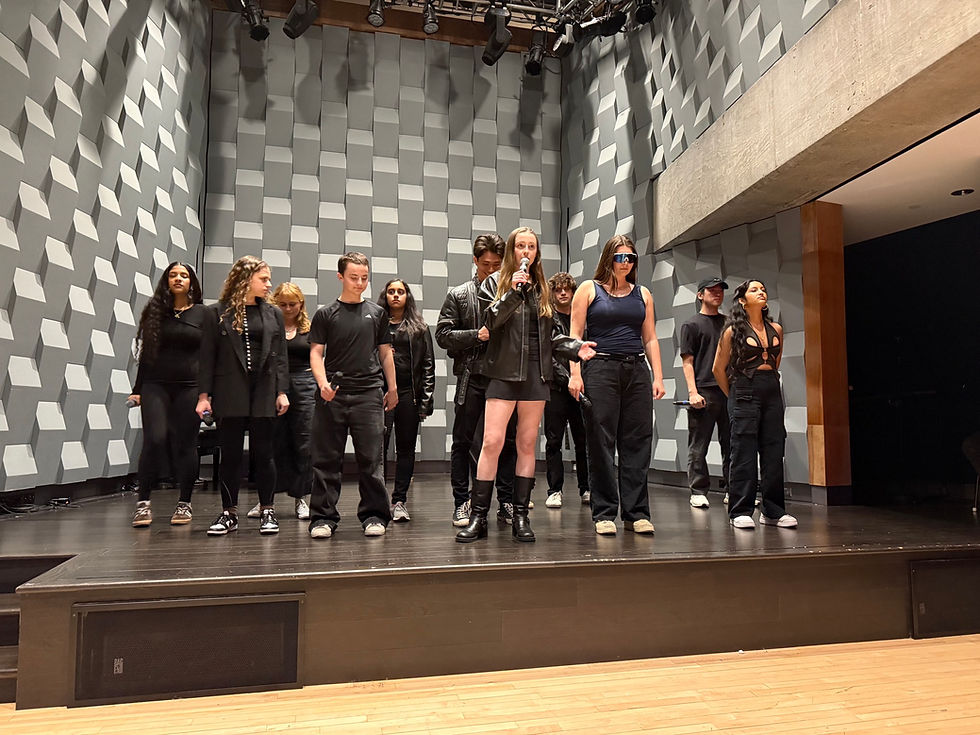
Outside of dancing at Barnard, Su is also heavily involved in ONYX, Columbia University’s Black and femme focused hip-hop team. Alongside music video shoots with a Y2K theme and high energy end-of-semester showcases, her favorite memory remains their first performance at Columbia’s night market. Su explains: “It was hosted by a bunch of Asian American collectives, and I loved it because coming from Georgia, I didn’t have this kind of representation in high school. That environment was just super special to me.”
Su carries that sense of belonging with her every time she steps on stage. She returns to a mantra a friend once shared with her: “You have nothing to prove, but everything to share.” This is a line that defines Su’s transformation from a gymnast chasing flawless execution, to a dancer grounded in joy. Now, her performances are not about proving herself but about sharing her truth.
Editor's Note: This story has been updated to correct the spelling of Bo Park.