Review: Columbia Musical Theatre Society’s 'Spring Awakening' revels in punk and teenage rebellion
Updated: Dec 16, 2025
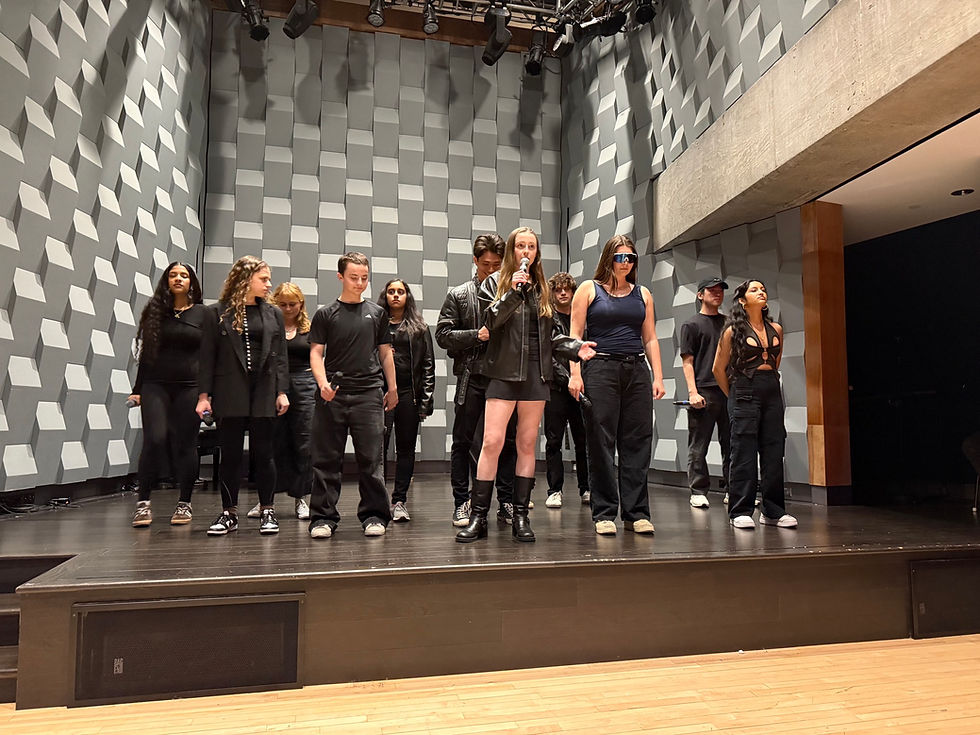
CMTS’s production of “Spring Awakening” electrified audiences during its three-show run in Barnard College’s Minor Latham Playhouse.

Photo Provided by Colson Struss
December 15, 2025
“Spring Awakening,” produced this semester by the Columbia Musical Theatre Society (CMTS), the oldest recognized student group that regularly mounts musical revivals at Columbia University, captured audiences during its three-show run at Barnard College’s Minor Latham Playhouse on November 14 and 15. The musical follows a group of teenagers exploring their sexuality in late-19th-century Germany. As director Kamila Boga (GS ’26) put it, “‘Spring Awakening’ is a coming-of-age story that investigates questions about shame, sexuality, and everything that arises at this period departing from childhood into early adolescence.” It is not by any means an easy play to tackle, but the production’s cast and crew made a beautiful job of it.
“Spring Awakening” questions the autonomy of youth and how important education is. In its opening scene, a teenage girl named Wendla (Kennedy Eagleton (CC ’27)) wonders how a baby is made, so she decides to ask her mother. Thinking she is too young to know, her mother refuses to tell her. “[Wendla is] the embodiment of naïveté, and we were interested in, ‘What does it mean for this person to really take matters into her own hands, to ask questions, to demand answers?’” said Boga. Eagleton conveyed Wendla’s curiosity, in asking her mother (Elsa Rose McIntyre Córdoba (BC ’28)), with a deep sincerity: she did not portray someone who just vaguely wondered about things, but one who was willing to have uncomfortable conversations. Eagleton’s portrayal highlighted Wendla’s dissatisfaction with not knowing. But because of Wendla’s youthfulness, her mother refused to tell her the truth, and this line of questioning and lack of education is what “Spring Awakening” revolves around as Wendla grows up to discover her own sexuality and what exactly that means.
Throughout the production, matters of sexuality were handled with care, through collaborations with a professional intimacy coordinator, Lauren Kiele DeLeon. “I think we were able, in collaborating closely with an intimacy director and the actors who played Melchior and Wendla, [to create] this depiction of sexual awakening that was unfamiliar rather than unsafe,” said Boga. They succeeded in allowing these characters’ sexual exploration to be born out of both of their wants, and, throughout the play, there were explicitly intimate moments that were handled delicately and beautifully. Eagleton and Michael Kitt (CC ’28), who played Wendla’s love interest, Melchior, portrayed such moments and had the audience holding their collective breaths.
In fact, the acting remained a strong point throughout the show. Every actor on that stage was able to tell their story with authentic physicality. This attention to authenticity is something Boga did her best to make sure of: “[The actors] would laugh at me because we have so many inside jokes with the way that I direct. There’s a lot of neutral language, so the joke is ‘I’m wondering if…,’ ‘I’m curious about…’. I really try to leave actors feeling empowered. I really try to let them explore their instincts and then refine them from there. We also had pretty in-depth discussions about the text.” These conversations led the actors to be able to play characters who have intense, emotional experiences. Melchior was an outcast; Moritz struggled with suicidal impulses; Martha was raped and abused by her father. Kitt’s performance was ferocious and determined; Cooper Orio (SEAS ’25), who played Moritz, presented mental health issues with delicacy, trembling hands and trembling struggle; Martha (Carolina Javier (BC ’27))’s troubles at home were expressed with truthful worry and fear, hands grasping at the hem of her shirt and troubled eyes. These aren’t easy topics to deal with, let alone to act through, but, through this production’s attention to detail and collaborative atmosphere, the actors were able to execute beautiful portrayals.
“So much of [‘Spring Awakening’] is an exploration of the body,” Boga noted. Beyond its nuanced acting, another strength in this adaptation was its choreography by Sarah Kaplan (BC ’27). “Every decision that we made about movement was rooted in storytelling, versus just dancing to dance. We’re dancing to make this message clear,” Boga said, explaining that the choreography and movement grew out of collaborative conversations between herself, her assistant, Ivy Randall (CC ’29), Kaplan, and Kaplan’s assistant, Ellie del Valle (CC ’28). She said, “It was just like ‘Okay, what is the function of this song? What changes from the beginning to the end? What do we need to get across?’” Again, much like the conversations had about the script, these conversations about the choreography helped make sure everyone understood the subject matter and was therefore able to tell a cohesive story. From the sharp, controlled, and uniform movements in “All That’s Known” — a song framed by its setting in the boys’ school — to the energized jumping around in “Totally Fucked” — a number that demonstrates the teenagers’ newfound youthful, fiery acceptance of and subsequent rebellion to their world — the choreography was thoughtfully used to further the plot.
Furthermore, there was notable intentionality in the creation of everyone’s costumes. Costume designer Rebecca Carter (CC ’27) had conversations with every actor about their character’s arc and how they felt they should dress. Although the boys didn’t wear actual school uniforms, there was a sense of rigidity with their outfits, and they didn’t have as much freedom in their costuming. However, Boga said, “we wanted [the ladies] to showcase more personality that wasn’t necessarily present in the text alone.” This was clear in the color of the costumes: the boys’ costumes were essentially all black, while the girls’ had more color. Wendla and her friends’ array of colorful costumes were often the only reprieve from the dark red and black of the stage design, placing the girls’ individuality on display. Costuming also played a part in plot development, since Wendla wore a pink coat at the beginning to mark her girlhood and naïveté but shed that layer as the show went on, wearing the more muted and adult colors of beige and white at the end of the musical. All these costumes, with their deconstructed layering of formalwear like blazers and dress pants with denim, plaid, lace, and fishnet, lent themselves to the punk, grunge vision the production immersed itself in, allowing the teenagers’ rebellion to fit in with the show’s aesthetic.
Nestled into a corner of the stage and constructed from members of the pit orchestra, the production’s very own rock band, titled “Ruby and Her Junk,” as an homage to pit director Ruby Farmer (CC ’28), was an integral part of the show’s punk aesthetic. Farmer, alongside Chelsea Chiu (CC ’27), music directed the production, amplifying the show’s rock-inspired musical score. “I really enjoy theatre that has some element of immersion,” Boga explained about the inclusion of the band onstage for the show’s runtime. “Everyone should feel like a rockstar on that stage and the band is a huge part of that.” This rockstar aesthetic poured onto the set design as well, with posters haphazardly hung, “BLAH BLAH BLAH” scribbled in chalk on the wall around them, and the aforementioned red and black color palette. This punk rock look, feel, and sound of the set helped integrate the feeling of rebellion that the teenagers grew into, letting the audience lose themselves in it, too.
Walking out of the Minor Latham Playhouse, I was left awestruck by the strength of this production and how every part of the musical came together to intensify the power in the story of “Spring Awakening.” From the intentionality in its costuming, set design, direction, and choreography, to the raw performances and onstage rock band, this production lent itself wholly to this show’s punk and only strengthened the catharsis of teenage rebellion in the face of a world that seems to only want to push you down.