‘At the diner on the corner’: Reflections on Barnard alumna Suzanne Vega’s ‘Tom’s Diner’
A photo essay and introspective exploration of Vega’s hit song and what it means for Barnard students now.

Photo by Abigail Rabbitt/The Barnard Bulletin
January 29, 2026
The city moves, and Suzanne Vega watches.
A 1982 Barnard graduate, Vega studied English literature and began building a music career, occasionally performing in Greenwich Village on weekends while a student. In 1987, Vega released her second album, “Solitude Standing,” featuring what would become one of her most well-known songs: “Tom’s Diner.”
Most know the melody. Some know that Vega wrote the song during her time at Barnard, inspired by her frequent visits to Tom’s Restaurant on 112th and Broadway. The song reveals Vega’s observational nature, allowing her to move quietly through New York while being shaped by the city in return.
“I am sitting in the morning at the diner on the corner”
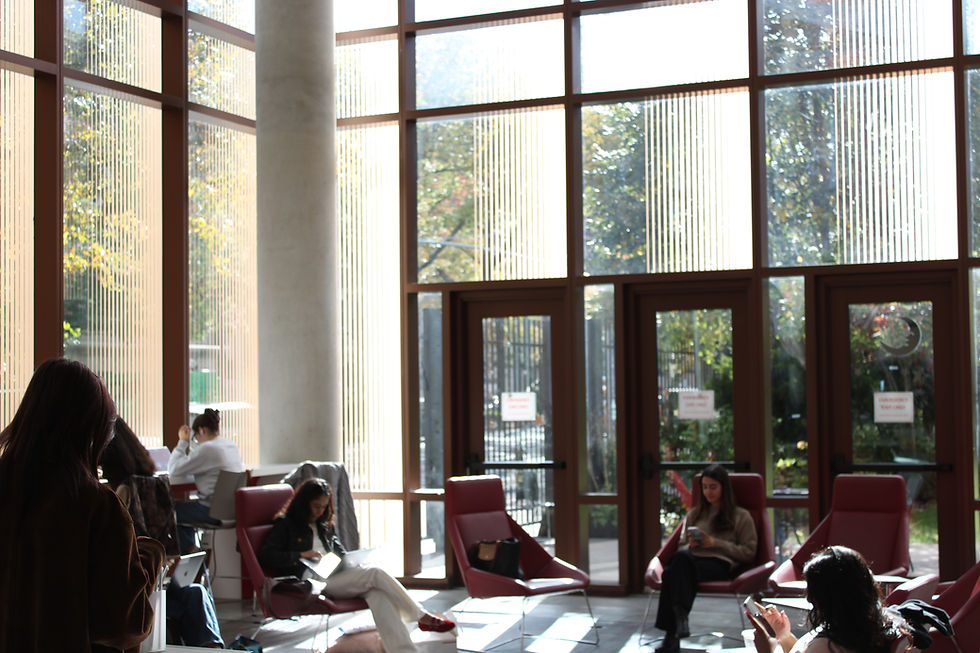
The opening line captures a familiar moment. Sitting near a window, perhaps with a notebook or laptop open, watching the neighborhood pass you by. That simple image alludes to a practice of women moving through the city, deeply observant, deeply intentional. It calls to mind the flâneuse: a woman who walks, watches, and documents urban life. Lauren Elkin, French-American writer and translator, popularized the term in her 2016 book “Flâneuse: Women Walk the City in Paris, New York, Tokyo, Venice, and London.” Elkin herself attended Barnard, and it was during research for her senior thesis class that she discovered the term flâneur, which refers to “an idle man-about-town.” Elkin wanted to study what the female version of that might look like, a figure that became entirely separate from the man. What is a woman in a public space? What power might she hold? Vega’s point of view is an integral part of that story. So is ours. The art of observing this city is shared across generations of Barnard students.

Photo by Abigail Rabbitt/The Barnard Bulletin
“I am waiting at the counter / For the man to pour the coffee / And he fills it only halfway / And before I even argue / He is looking out the window / At somebody coming in”
Everyone around us has a world that exists independently of our own. For the briefest of moments, the man behind the counter exists only in Vega’s observation, until the intersection of their lives is interrupted. The small rituals of a slow morning at a diner become a reminder that the neighborhood is not just a backdrop for a college experience. As students, we occupy these streets temporarily but significantly. We benefit from the expansion of Columbia University, its dining halls, its housing, its extensive influence and power. We live beside a community that has been systematically reshaped by the growth of the institution. It becomes very easy to become absorbed in our routines as students, becoming increasingly unaware and immune to the lives unfolding around us and the impact of our very presence. How different is the corner I watch today from what Vega saw so many years ago? A watchful eye notices how places change and who gets to stay.

Photo by Abigail Rabbitt/The Barnard Bulletin
“There’s a woman on the outside / Looking inside, does she see me? / No, she does not really see me / ’Cause she sees her own reflection”
Vega describes herself looking through the window at another woman who is not looking back at her, but at her own reflection in the darkness of the glass. She observes the flâneuse before her, a woman on a walk, watching and looking. Both women exist in tandem as the observed and the observer - what happens when the two meet? This image captures a tension in the existence of the flâneuse: the simultaneous act of seeing and being seen or unseen. As artists and writers and scholars, Barnard students learn to practice this balance. The city impresses itself upon us in rhythms and sounds, and it becomes our job to leave something of ourselves behind, imprinting a piece of our consciousness and observations in the movement.

Photo by Abigail Rabbitt/The Barnard Bulletin
“I open up the paper / There’s a story of an actor / Who had died while he was drinking / It was no one I had heard of / And I’m turning to the horoscope / And looking for the funnies / When I’m feeling someone watching me / And so I raise my head”
There is something distinctly unsettling when the quiet and personal moment of reading the news is met with the sudden awareness of being seen. The back of your head illuminated in The New York Times, your friend’s name among a list of suspended and evicted. The streets outside of Columbia and Barnard’s gates have frequently been filled with protests and powerful displays of student and community movement. From labor demonstrations to the countless protests against Columbia’s investments in Israel’s war in Gaza, headlines and news media tell one story, while the experiences on the street reveal another. Walking past a protest or walking with one requires a deep understanding of both the narratives that the media might create as well as our position as observers and participants. In the past few years, Columbia has become a living archive of a movement that, in many ways, has set the current tone for response to activism and free speech in the United States. Every act of witnessing, like Vega’s observations, becomes part of this archive. We sit at windows and watch, or we stand on streets and scream, shaping meaning out of motion and leaving behind our own reflections for those who will come after us.

Photo by Abigail Rabbitt/The Barnard Bulletin
“And I finish up my coffee / And it’s time to catch the train”