

Barnard’s commitment to equity does not include disabled students
Updated: Aug 30
During the 2024-2025 academic year, 33.9 percent of Barnard undergraduates self-identified as disabled. So why is being disabled at Barnard so taboo?

Photo by Gabriela Valentin/The Barnard Bulletin
By Alexandra Malinowski Spiegel
February 16, 2026
In February 2017, the President’s Task Force on Diversity and Inclusion adopted a mission statement that declared, “Barnard’s core mission is to rigorously educate and empower women, providing them with the ability to think, discern, and move effectively in the world.” Sounds nice, right?
The mission statement sounds especially nice when one considers the 33.9 percent of Barnard students who self-identified as disabled during the 2024-2025 academic year. Disabled students have long been left behind in higher education, and the promise of an institution committed not only to promoting their faculties but also their ability to access the world at large is particularly alluring.
Although the task force acknowledged the importance of a “diverse, inclusive, and equitable” Barnard community and “an environment where no voices are silenced and all of us can thrive,” it said little about how such could be accomplished. Their statement was not a mission but a daydream — it lacked actionable goals and presented instead an imagined utopia.
Nine years later, diversity, equity, and inclusion initiatives have become initiatives of inclusion and belonging, and Barnard says it is dedicated to “enhanc[ing] accessibility,” yet Barnard, its programs, and its properties are not particularly accessible. It is difficult for disabled students to belong.
During the 2024-2025 academic year, 1,108 of Barnard’s 3,269 students self-identified as having at least one form of disability. Disabled students thus constituted 33.9 percent of Barnard’s student body, while students with multiple disabilities made up 38.4 percent of the subpopulation, or 13 percent of all students.
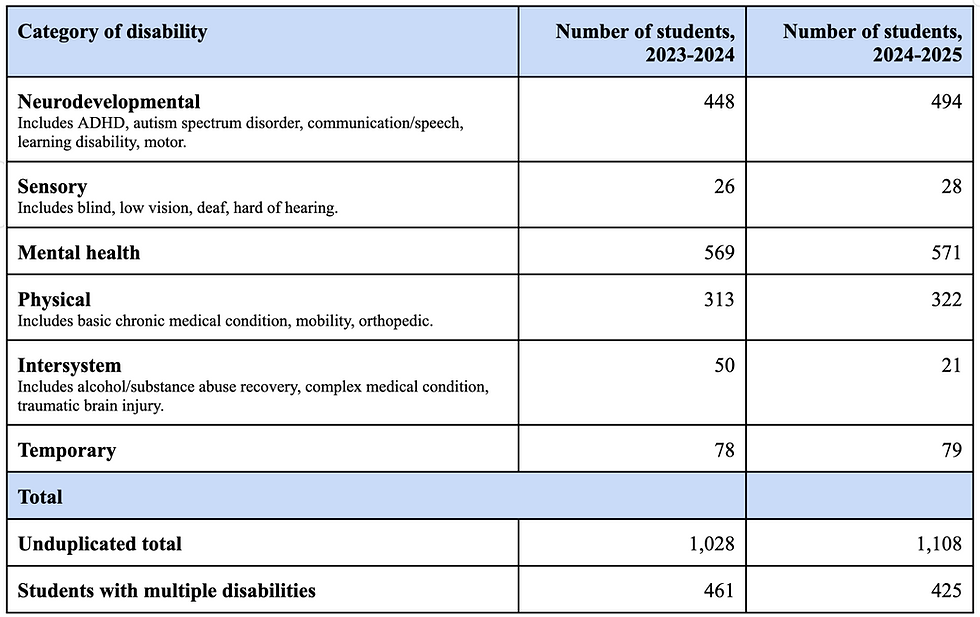
Self-identified student disabilities at Barnard College, 2023-2024 and 2024-2025.
Source: New York State Education Department, 2026.
A slightly smaller 31.9 percent of Barnard students self-identified as disabled during the 2023-2024 academic year. Then, the Center for Accessibility Resources & Disability Services (CARDS) had only the equivalent of six full-time employees to serve as many as the 1,028 matriculated disabled students. Two years later, the prevalence of self-identified disability at Barnard has increased, but CARDS’s website still lists six employees.
The College has not set the department meant to serve disabled students up for success. Thus, the College has not set disabled students up for success.
In the fall of 2023, I began my sophomore year, and I did so as one of only 313 students with a physical disability. The next year, I was one of 322.
I have achondroplasia, the most common form of dwarfism, and the same form as Emmy and Golden Globe-winning actor Peter Dinklage. Achondroplasia results from a mutation in the fibroblast growth factor receptor 3 gene, decreasing the rate of bone growth. Consequently, my access needs are primarily related to the height of facilities — facilities I cannot reach and need a tool or other accommodation to navigate — and pain management.
During my first year, I waited over seven months for a properly working accessible shower in my residence hall — there were three weeks left in the spring semester when I could finally shower comfortably in my own dormitory. The “accessible” alternative I was told to use in the meantime was not in my hall, nor was it actually accessible by personal or legal standards. The substitute shower necessitated multiple work orders to even approximate accessibility.
What made managing the bureaucratic battle to bathe especially frustrating and equally exhausting was the fact that Barnard was well aware of my disability before I moved in — I was registered with CARDS and submitted appropriate documentation of my dwarfism during the housing application process. I did not request a semi-private bathroom because I had no need for that privacy and nowhere did Residential Life & Housing or CARDS tell me that certain communal bathrooms in the Quad were not accessible.
Inaccessibility was not my fault, but even if it was, it should not have taken so long to reasonably and thoroughly accommodate me. Yet it did, because the College consistently treats disability like an anomaly.
The College claims to be committed to diversity, equity, and inclusion, yet it treats disability like an anomaly and actively stigmatizes the use of tools that serve marginalized people, making equity and inclusion possible.
For evidence of this, I point to Milbank Hall. As of December 3, 2025, there are laminated papers posted outside the elevator on each floor, enthusiastically suggesting that students, faculty, and staff take the stairs instead. This message can be found outside elevators in Barnard Hall and the Milstein Center as well.
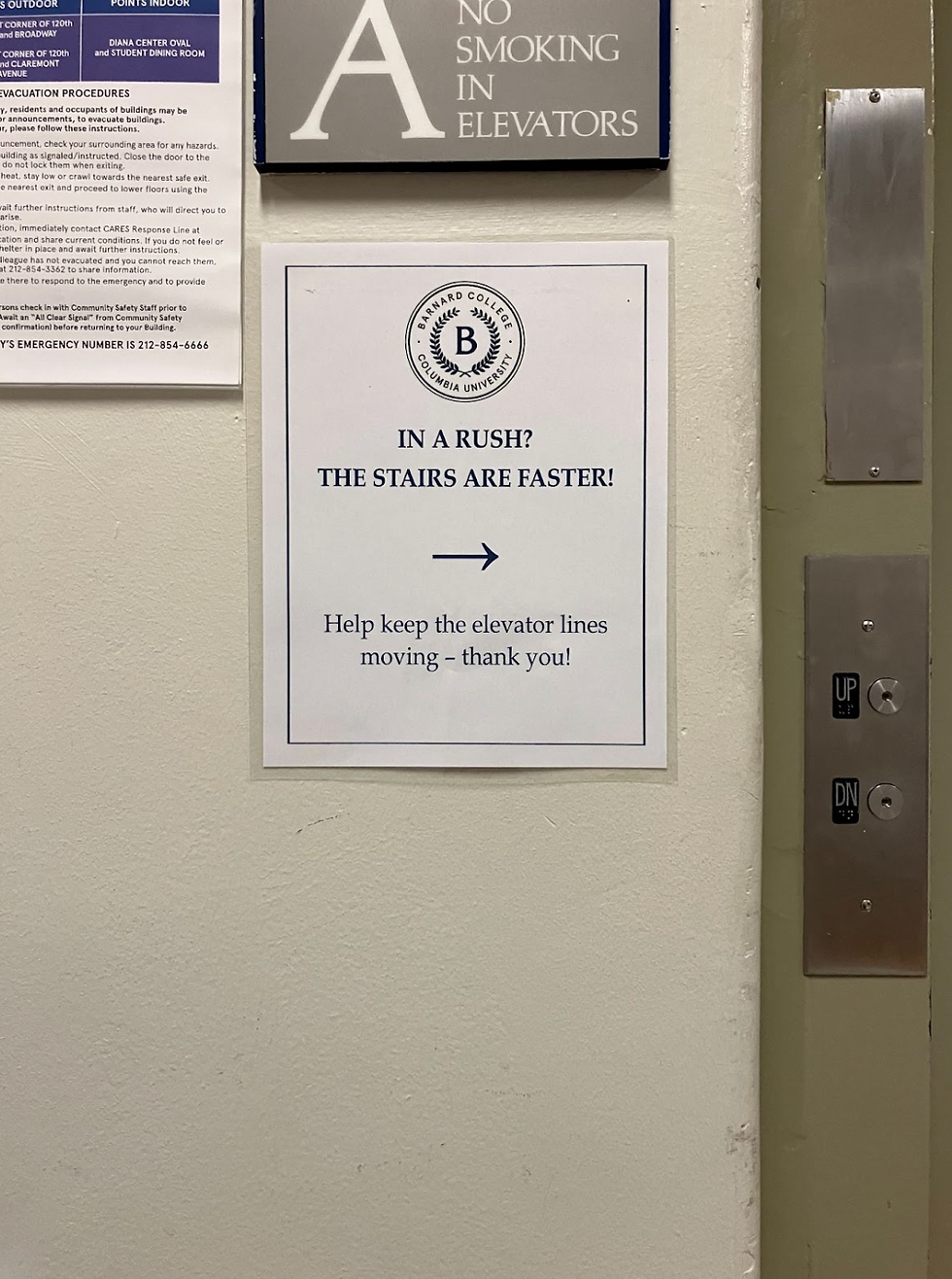
A sign posted outside the elevator on the third floor of Milbank Hall. It says, “In a rush? The stairs are faster!” An arrow points to the right to direct readers. “Help keep the elevator lines moving – thank you!”
Photo by Alexandra Malinowski Spiegel/The Barnard Bulletin
Barnard claims to be committed to equity and inclusion, yet accessibility always seems to be an afterthought.
I say that accessibility seems to be an afterthought because the same Milbank elevator was taken out of service at some point before I made the trek to my 4:10 p.m. seminar on Wednesday, February 4. When I arrived at the basement elevator bank, there was a loose piece of paper taped to the wall stating that the elevator was out of service. Because I had time and the ability, I climbed the stairs, but not without significant pain and effort expended — the Milbank stairs suck.
CARDS students were notified by email Thursday morning and only at 5:44 p.m. on Friday, February 6 was an email sent to all members of the Barnard community, sharing that repairs might not be completed for several weeks.
Another email sent the afternoon of Tuesday, February 10 informed the community of the elevator’s restoration. However, that the College did not notify students of an interruption to access for over 48 hours, during which classes were in session, is evidence of just how much of an afterthought disabled students are.
But inaccessibility is nothing new to Barnard, and it surely is not limited to the Milbank elevator.
When one presses the push-to-open button to enter the Diana Center, often only one of the two notoriously heavy doors opens. When going in, only the external door opens, and when going out, only the internal does — that is, if either opens at all.
Furthermore, it was only in the middle of the fall semester — when Barnard instituted ID-swipe procedures for Quad access — that students could rely on the doors into Sulzberger Hall to open when prompted, finally not necessitating manual labor.
Now, four weeks into the spring semester, the doors again do not reliably work. Only about one-third of the time do both sets of doors open when prompted — the internal set alone opens most of the rest of the time.
Nevertheless, the College continues to promise its accessibility.
“Barnard is committed to making our campus as safe and accessible as possible for all members of our community,” a Barnard spokesperson wrote in a statement to The Bulletin. “The Center for Accessibility Resources & Disability Services (CARDS) works closely with students and with offices across the College - including Facilities, the Registrar, and the Provost’s Office - to understand individual needs and make appropriate accommodations. As individual situations arise, we work with affected students, faculty, and staff to identify solutions as quickly as possible. We encourage any student with concerns to reach out to CARDS for support.”
Repeatedly emphasizing the “individual” effectively frames disability as a personal problem, a singular phenomenon. If a student needs accommodations or is dealing with inaccessibility, that is theirs alone — an individual problem, not a societal or institutional one.
I also stress the College’s action “[a]s individual situations arise.” To actually be accessible and equitable, proactivity is necessary; reaction is not enough. And, in situations like the Milbank elevator outage, where perhaps reacting is all that can be done, the College needs to react faster.
Promises of accessibility do not automatically mean practices of accessibility — the fact of the matter is that the College is not accessible in practice.
It needs to be.
Access is a right, not a privilege — as the Americans with Disabilities Act (ADA) established in 1990 — and disabled students deserve access.
Disabled students at Barnard should not have to fight for the right to exist.
Because that is what it is to go up against the bureaucracy, to call and email countless departments over and over again and then wait weeks, if not months, for resolutions to problems that affect — and sometimes prevent — bathing, eating, resting, studying, and simply being.
To be disabled at Barnard is to fight for the right to live and learn with even a semblance of the ease your able-bodied peers do. Being disabled at Barnard necessitates an immense amount of effort, effort which makes just being at Barnard exhausting.
And that is what I mean when I say that disabled students fight for the right to exist at Barnard.
It is not enough to admit disabled students, to eventually accommodate them. Disabled students — like all students — deserve equity and access. The ADA tells us so, and, hypocritically, so does the College, stressing time and time again the value of “an environment where no voices are silenced and all of us can thrive.”
So, to the College, I ask one thing: how can you claim to be preparing disabled students to “move effectively in the world” when disabled students cannot even move effectively inside the gates?
Alexandra Malinowski Spiegel is the Head Copy Editor of The Barnard Bulletin for the 2025-2026 academic year. She is a member of Barnard College's Class of 2026, where she is majoring in English.


