

Decolonizing the liberal arts
Updated: Aug 30
Elite colleges promise diversity. While mostly successful, students say their curriculums still reflect uneven, often Western-centric frameworks.
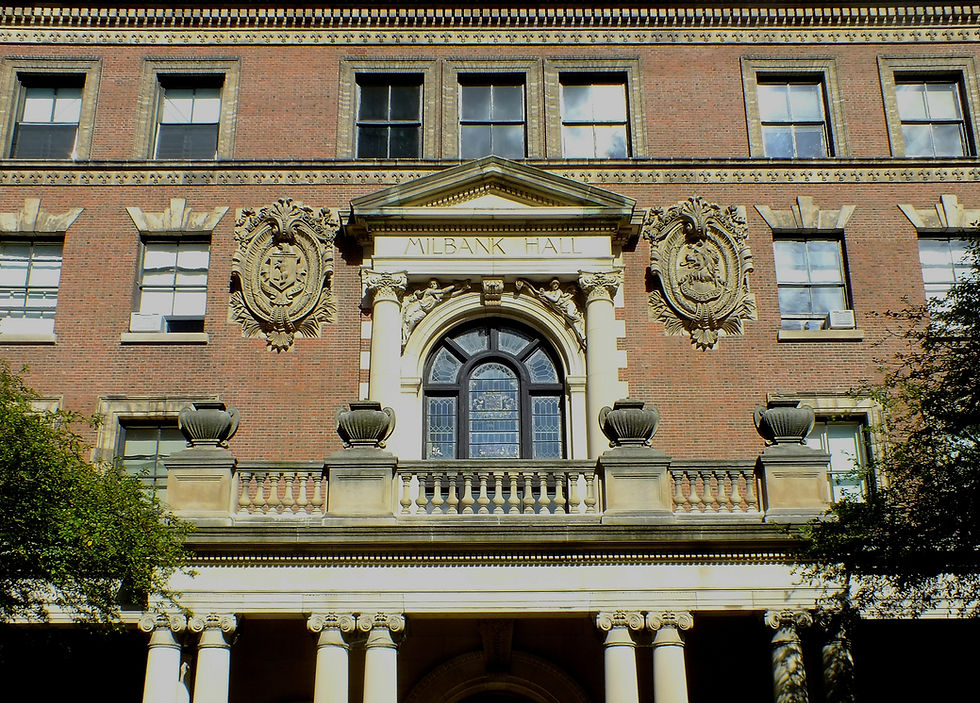
Photo by Vernon Demir/The Barnard Bulletin
By Pai Sinpatanasakul
December 9, 2025
As Barnard reaffirms its commitment to diversity, students are asking whether the curriculum still enforces long-standing academic hierarchies. Interviews with students suggest a complex picture: one where most curriculum policies successfully decolonize academia, while a handful of structures continue to perpetuate outdated norms.
The “decolonization of academia” questions whose perspectives, histories, and knowledge are prioritized in the classroom. A decolonial initiative is successful when it increases representation, diversifies who is centered, and makes marginalized or global perspectives heard. It is a failure when changes are merely symbolic, inconsistent, or Eurocentric — defined as interpreting the world through European beliefs and values. The lack of non-European or non-Anglo-American voices has been a long-standing issue in academia. It is essential to expand the curriculum beyond Eurocentricism to make underrepresented voices heard.
Computer science major Emily Tan (BC ’27) believes Barnard’s distributional requirements have been her primary doorway into disciplines she would not otherwise encounter. “Because I’m in STEM, it’s hard to naturally connect with a lot of histories and voices,” she explains. “The requirements broaden my scope.” She points to "Introduction to Urban Studies," which “reshaped how [she] viewed suburban life” and exposed her to social and historical complexity that her major does not usually cover.
Meanwhile, Catherine Li (BC ’28) points to the “Thinking About Social Difference” Foundations requirement, which clearly shapes whose voices enter the classroom. Filtering courses by this requirement on Slate, they say, yields “a pretty diverse list” of classes that discuss race, sexuality, gender, and other forms of identity. However, Li emphasizes that much of the diversity they see comes not necessarily from the curriculum itself but from faculty initiative: “My First-Year Seminar and First-Year Writing professors made an effort to include material that was not just cishet white authors. I’m not sure how much is because of the requirement or because of the professors.”
They also note a relative lack of queer voices in classes that are not explicitly queer-focused, though they feel Barnard highlights diverse voices through its distributional requirements, such as First-Year Seminar and First-Year Writing.
Tan notes that while some historical fields can be dominated by Western or male narratives, her experience at Barnard has been that professors work proactively to counter that pattern. In her “History of the United States 1940-1975” class, Tan says the professor “did a good job including multiple perspectives and centered historically unheard voices” in dedicated lectures.
When reflecting on the broader campus climate, Tan says Barnard strongly markets itself as a diverse institution. While she has not personally felt marginalized, she acknowledges that “I have heard from other people that they felt otherwise,” suggesting a potential gap between institutional messaging and student experience — though she emphasizes that she has not witnessed this disconnect firsthand.
Other liberal arts colleges face similar debates over representation and diversity in their academic requirements. For Wellesley junior Sharon Xu, distribution requirements offer breadth rather than boundaries. Wellesley’s system divides requirements into broad areas — ranging from epistemology to historical studies to religion and ethics — giving students “freedom to choose their subjects of interest.” She notes an explicit multicultural requirement and says she has never felt restricted to a single worldview by the core curriculum.
At Wellesley, Xu feels the nature of the campus community and coursework asks students to “engage in critical thinking” and exposes them to multiple worldviews. Xu praises Wellesley as a place where diversity is “highly emphasized everywhere,” with events, student spaces, and resources available for underrepresented groups. She says the campus culture encourages students to speak up when they feel unseen.
Xu’s experiences echo Li’s: most Wellesley classes prioritize critical engagement, but some foreign literature courses still feature analyses that feel “somewhat Eurocentric.” She also points to institutional decisions that undermine decolonial values, citing the sudden termination of a professor in the Korean department that took on initiatives to share Korean culture following budget cuts. She was one of the three professors in the department. For her, decisions like this “go against” the College’s stated diversity goals and have broader implications for underrepresented language departments and international, non-tenured faculty.
All three students’ visions for a decolonized liberal arts curriculum return to the question of institutional priorities. Xu imagines a system centered around “diverse faculty allowed to teach their subject of passion” and an administration aligned with its mission and “people-centric.” Li desires structural diversity in coursework that is matched by institutional accountability, not left to individual professors. Meanwhile, Tan enjoys that the Barnard curriculum exposes STEM students to histories and perspectives they would not otherwise encounter.
Though students report that liberal arts colleges have made great strides in expanding their curricula beyond the Western perspective, improvement in the classroom is always welcome. Instead of settling, Barnard students should continue to critically examine whose knowledge is centered, whose is missing, and how core requirements can uplift those voices.


