Celebrating nine years of Greta Gerwig’s ‘Lady Bird’
November 3, 2026 is the ninth anniversary of Greta Gerwig’s (BC ’06) masterpiece. The alumna’s undergraduate years at Barnard deeply shaped “Lady Bird,” a film that is anchored in the ultimate mother-daughter love story.

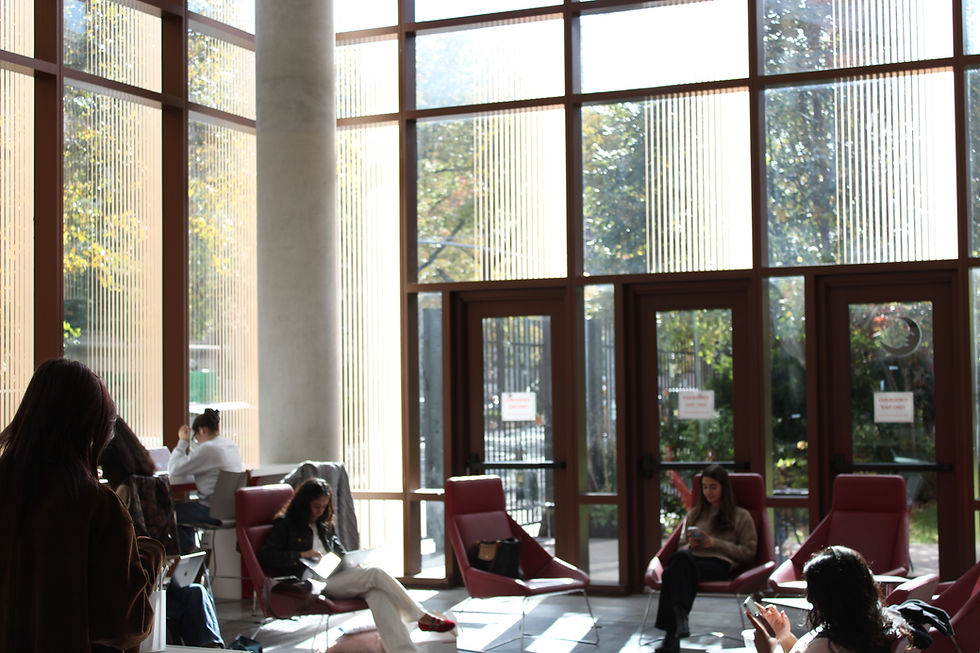
Photo by Julieta Skallman/The Barnard Bulletin
By Katie Lam
November 3, 2026
November 3, 2026 is the ninth anniversary of Greta Gerwig’s (BC ’06) masterpiece. The alumna’s undergraduate years at Barnard deeply shaped “Lady Bird,” a film that is anchored in the ultimate mother-daughter love story.
There is a very specific type of rebellious yearning born in mandatory chapel services. Mine took place within the suffocating walls of a British all-girls’ boarding school. Standing with my hip jutted out while the chaplain went on and on, my eyes would drift past the stained glass into the rural horizon where my mind could run free, fantasizing about a future life where I could spread my wings in a bustling city like New York.
This exact restlessness forms the driving undercurrent in Greta Gerwig’s “Lady Bird.” In one scene, Christine/Lady Bird (Saoirse Ronan) lies upside down, chomping on unconsecrated communion wafers with her best friend, capturing Gerwig’s own desperate desire to flee the suburbs of Sacramento for the East Coast “where culture is.” This impatient yearning of sitting in a boarding school dorm at 2 a.m., living vicariously through my laptop screen as I virtually walked through the gates of Barnard College on Google Maps, is an ache many of us share. It hits even harder knowing that Gerwig herself once walked the same campus paths, daydreaming about the very stories that would capture her teenage experiences on screen.
The blueprint of the artist Gerwig became is vividly preserved in the memories of Professor Patricia Denison, who served as Gerwig’s adviser throughout her years at Barnard and was her professor of Modern American Drama and Performance. When asked about “Lady Bird,” Professor Denison’s face lit up. “It was so Greta!” she said.
Throughout our conversation, Denison’s recollections of Gerwig were vivid, as if the former student had only just left the seminar room. “There’s a moment in ‘Lady Bird’ where the character talks about coming to New York. She told the admissions department that if they turn her down, she’ll be back and apply again next year. I mean, that just captures Greta, her determination to move on, to move into another world. She had a very clear sense of where at any moment she wanted to be.”
“When she walked in the room, she radiated almost a sort of joy about her,” Denison recalled. Long before Barnard established its maximum credit rule, Gerwig would overload her schedule each semester, driven by an insatiable hunger to explore every corner of the liberal arts curriculum, eventually picking up a philosophy minor because she was so fascinated by different ways of thinking.
Denison keeps a piece of that Barnard history tucked away. Reaching into her archives, she pulled out a relic from the past: a page covered in Gerwig’s own undergraduate handwriting, preserved for over two decades. In it, a young Greta had written her reason for joining Denison’s seminar: “My reason for wanting to take this class has less to do with being an English major and a Theatre concentrator, but more because I need to reinvest myself in the belief in American dramatic and literary traditions.”
Gerwig treated the seminar table as a place to resurrect her artistic faith. That drive is alive and well in Barnard’s classrooms today. Looking around my own seminar table, I see that same spark in my peers as they dissect texts and analyze art, bridging history, literature, and our own lived experiences with every discussion.
When asked if she had a favorite moment in the film, Denison didn’t hesitate. “I love the moment of her throwing herself out of the car, and her mom just screams,” she said. “I think that was just like Greta. Oh my, she might at any moment do something completely unexpected. In life, you have to take risks, and that was her. I thought that scene captured a vital part of who she is.”
Denison’s favorite scene captures the heart of “Lady Bird”. The movie is about the complex love story between mother and daughter, who love each other too fiercely to ever quite know what to say. Instead, they weaponize their affection through explosive arguments, hurled insults, and throwing themselves out of moving cars.
We are conditioned to look for love in a cinematic heartthrob, following the classic trope of the coming-of-age crush. In “Lady Bird,” we have Kyle, played by Timothée Chalamet, who plays bass in a band and exhales cigarette smoke over the pages of his paperback. But Gerwig pushes Kyle to the side, reducing him to a mere side plot as the true love story unfolds within the home and the rearview mirror shared by Lady Bird and her mom, Marion. Their relationship is portrayed as an umbilical bond constantly subjected to pushes and pulls, swinging from shouting matches one minute, only to hold each other in a tight embrace, spilling tears, in the next.
When Marion finds out that Lady Bird applied to a college in New York City behind her back, she retreats into a punishing silent treatment. We see Lady Bird’s usual fiery armor break as she is stripped down to her rawest vulnerability, pleading into the void of her mother’s cold shoulder: “Please, Mom, please. I’m so sorry, I didn’t mean to hurt you. I appreciate everything you’ve done for me, I’m ungrateful and I’m so sorry, I’m so sorry I wanted more … Just please, talk to me. I know, I know I’m so bad.”
Trailing her from counter to counter, Lady Bird actively courts her mother’s gaze, only to be faced with maternal rejection, a moment that proves a mother’s silence can become far louder and infinitely more destructive than any shouting match they’ve ever had.
Though a place like Barnard inspires its students to be bold and fiercely independent, the archetype of the “bold, beautiful Barnard” student cannot fully shield us from the quieter aches of growing up as we step into adulthood. For many of us, the journey to Morningside Heights meant leaving behind our homes, parents, and the deeply formative landscapes of our high schools. Opening the Barnard acceptance letter, the computer screen gleaming with a virtual burst of blue confetti, jaws agape, screaming at the life-altering text “Congratulations, Class of 202X” is a core memory we all share. Yet, stepping onto campus does not mean we have crossed the ultimate finish line, where prior problems vanish and life magically begins. Rather, it becomes an entry into a complex college world where we must continuously evolve, grappling with the grief of past versions of ourselves and the loved ones we have left behind.
Having written my Barnard application essays on Gerwig, I viewed her as the ultimate archetype of a bold Barnard woman. Yet, “Lady Bird” reveals that even an A-list film director was once a confused college student, navigating this confusing journey of growing up. When Lady Bird is confronted with the pages of Marion’s late-night letters to her, with sentences frantically crossed out for fear of being judged or mocked by her college-educated daughter, she immediately calls home. Perhaps the scene serves as a reminder for us to take a moment and pause, that beneath our busy schedules and the thrill of our newfound independence, we should pick up the phone and call home, as a parent is always patiently waiting at the other end of the line.
I am now at Barnard, no longer wearing the long plaid kilt of the boarding school uniform, and miles away from the chapel services that defined my years of yearning. I am sitting in the same office hour chair that Gerwig once occupied, navigating my overloaded schedule just as she did. Later tonight, when I make my long-distance WhatsApp call home, my mom will infuriate me, and I will want to hang up on her. We will push and pull across the ocean and time differences. But as the call ends and I am left in silence with my thoughts, I realize we are all daughters trying to navigate this love that feels too heavy to articulate, until we finally find the courage to say thank you.