

Do you have games on your phone?
Video games — particularly mobile games — hold a significant role in society. How common are mobile games on the Barnard campus? What are Barnard students' opinions on video games?
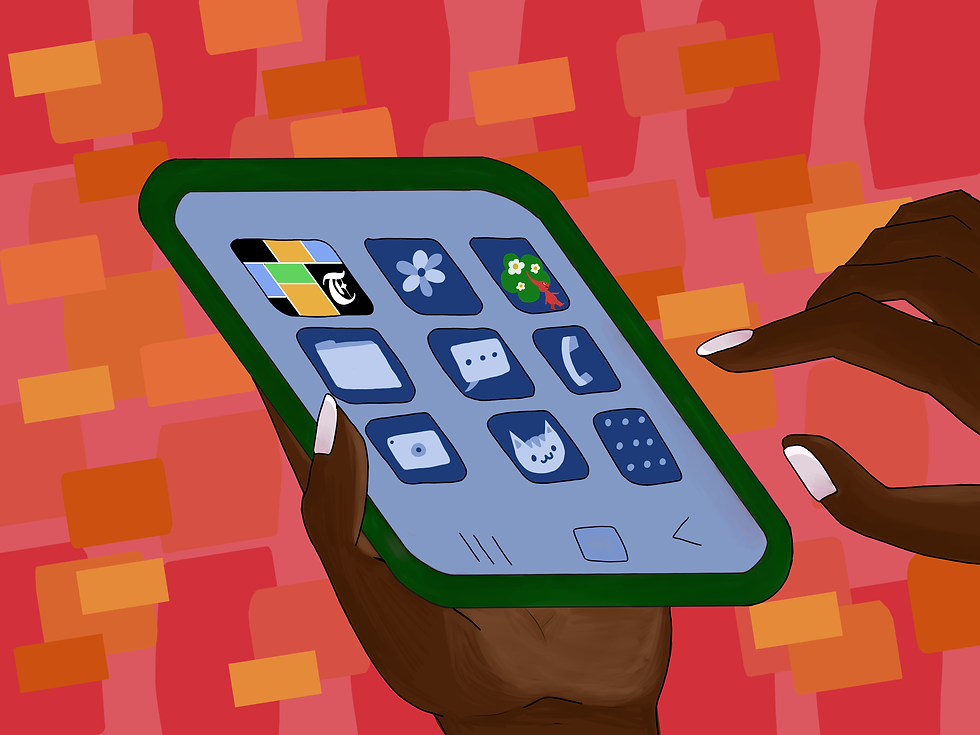
Artwork by Vernon Demir/The Barnard Bulletin
By Zainab Anwar
January 24, 2026
Despite their prevalence in stores today, video games did not start in living rooms or on phones — they began in physics labs. Back in 1958, physicist William Higinbotham created what is widely regarded as the first video game, called Tennis for Two, displayed on an oscilloscope at a science lab’s open house. During the 1960s, 1970s, and beyond, advancements in computing and graphics ushered in arcade games, home consoles, PC gaming, and eventually the complex interactive worlds we see today. The early 1990s saw primitive games on the mobile phone, and, in 1997, Nokia released its 6110 handset preloaded with Snake. Snake became a global phenomenon, with over 350 million downloads to date, proving that phones could be gaming devices — and that gaming could be portable, casual, and accessible in ways previously unimagined. Since the rise of Snake, video games have contributed to the childhoods of many Barnard students — from Roblox, a common one among those interviewed, to more niche games such as Raft.
Part of the reason behind the success of video games requires a dive into how video games impact the player. The first component to point out is dopamine, a neurotransmitter that signals pleasure and reward — it feels good. When a player finishes a challenging level, unlocks a new item, or wins a match, their brain gets a hit of dopamine. That rush reinforces the behavior, creating a feedback loop: the player does something like win or complete a level, gets rewarded by releasing dopamine, then the player is driven to feel that happiness again, and thus repeats the action.
What can make many modern games — especially mobile games — dangerous is that they become addictive due to how they have been intentionally designed around this loop. Features that are random, unpredictable, and irregular mimic the psychology behind gambling: your next win could come at any moment, but you do not know when. That unpredictability heightens the dopamine-driven reward sensation and makes it harder to put the game down. At the same time, it helps explain why many people use games as a coping mechanism, especially when life feels overwhelming or monotonous. Since games consistently stimulate the reward center, they offer a form of relief or satisfaction that can feel easier to get than through everyday activities on campus. The issue of gaming addiction has become prevalent enough to be referred to as gaming disorder.
However, video games can impact the brain in ways other than the addictive dopamine loop; they can also offer cognitive, emotional, and social benefits. Playing video games can strengthen spatial navigation, reasoning, memory, and perceptual skills, sometimes to a degree on par with formal training. Gaming often challenges players to react quickly in complex, moving environments, thus the brain gets repeatedly pushed to coordinate attention, spatial reasoning, and hand-eye coordination. That translates outside the game: improved visual-spatial reasoning and faster decision-making can help with everything from learning scientific or math concepts to real-life multitasking. Beyond pure cognition, games may also support emotional health. As mentioned, playing games can boost mood, help with relaxation and stress relief, and even foster emotional resilience because games typically involve repeated failure and retry cycles, which train you to handle setbacks, manage frustration, and persist.
This evolution, from a physics lab’s invention to an attention-grabbing game in everyone’s pocket, laid the groundwork for today’s mobile game phenomenon. I decided to look into the perception of video games, with a focus on phone games, on Barnard’s campus. How common is it to find Barnard students playing them? Why do they have games on their phones? Or why do they not?
I went around campus asking students the titular question: “Do you have games on your phone?” Of the 14 I spoke with, 11 said yes, two said no, and one declined to comment. The student who declined claimed they did not want to share their thoughts on video games , speaking to the stigma toward video games that I will delve into later. I questioned a few students on their reasons for having or not having games.
Alexa Chebli (BC ’29) said, “I used to play the games back in sixth grade. Now, I just keep them, but I don’t actually play games anymore. I spend more time on social media now.”
Another student, Marina Avelar (BC ’28), stated that “usually when I don't have Wi-Fi, I play them” and that she plays them “for fun [and] they’re relaxing”. This was a common sentiment among all the students, that video games served as a quick and fun way to take a break.
Although they are viewed positively as a fun pastime, a few students mentioned the cons of video games that held them back from playing at all, or as frequently as they used to. Catherine Thomas (BC ’28) stated “I used to have [them], but I don’t play them enough so my phone automatically undownloads them. I used to play with my cousins as a [bonding] thing.”
Among some who stated not having games or not playing them very frequently, the biggest reason was due to their addictive nature. However, as I mentioned earlier, one student presented a distaste for video games due to perception of what it means to be a “gamer.” This led to the idea of how video games are viewed by the general public, and the stigmas surrounding them.
Stereotypes around video games, mobile or otherwise, still shape how society views the people who play them. A lot of this comes from the long-standing association between gaming and childhood. Since kids make up a major share of the gaming audience, the hobby often gets dismissed as something you are supposed to “grow out of.” This mindset creates a stigma for adults who continue to play, where gaming gets written off as unproductive, unprofessional, or even anti-social. The narrative partly stems from public anxiety about the addictive qualities of games — a valid concern in specific contexts, but one that is often used to define all players. The “typical gamer” is still imagined as an isolated person who prioritizes gaming over responsibilities and real-world connections. However, the stigma often pushes the greater majority of players to hide something that actually helps many people relax, manage stress, or feel connected to others. As a result, this can isolate people even more, reinforcing the exact stereotype society claims to be worried about.
I witnessed this dynamic while talking to students on campus. As we spoke, they were able to open up in conversation about their own habits with mobile games, describing how they use them to take a quick break from working or as a part of spending time with friends. However, when I asked if they were willing to go on the record, most declined. It was evident, through their explanations, that societal expectations have pushed video game enjoyers to go into hiding. Until that stigma eases up, and people view both the pros and cons equally, a lot of players will keep their interest under wraps, not because they are isolated, but because they are tired of being misrepresented.
Video games come with a long, complex history, from the people who create them to the players who shape their impact. They sit at an intersection of technology, culture, and social interaction. From being a key component of the first steps toward AI achievements, to shaping global communities through digital platforms, to being an addictive vice, there are many pros and cons to video games. On Barnard’s campus, games are perceived differently across students. For some, they function as a practical part of daily life: an activity to do on the subway, a quick mental reset between tasks, or a casual way to spend time with friends and family. For others, they are irrelevant, something that they do not personally enjoy or never were inclined to try out for whatever reason. The mixed perceptions of video games on campus is indicative of how society views them at large. In the end, video games find their place at Barnard as both a distraction and tool — depending on which students you ask.


