

The Columbia women’s basketball team: A midseason review
Do the Lions have what it takes to win a fourth consecutive Ivy League title?
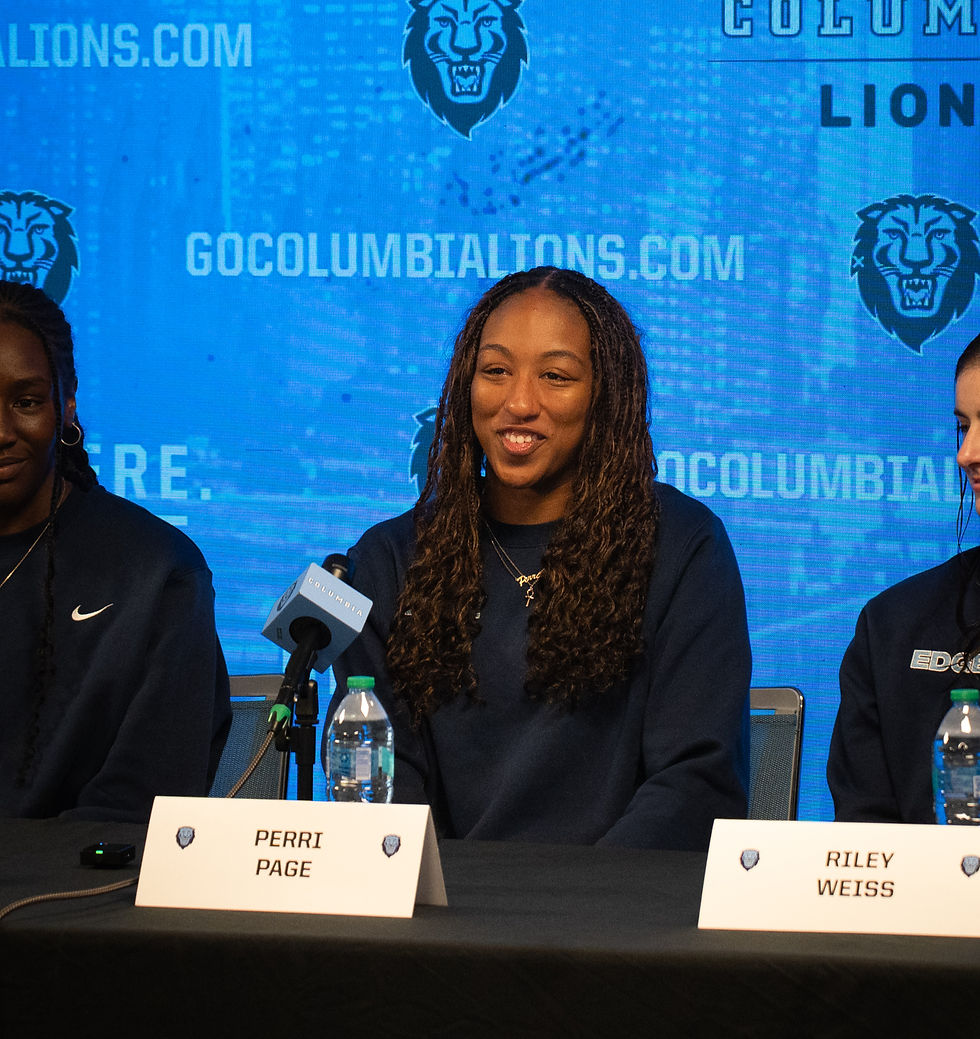
Photo by Sophia Arango/The Barnard Bulletin
By Maitree Mody
February 9, 2026
With two seconds on the clock and Seton Hall clinging on to a one-point lead, Perri Page (CC ’26) dribbled, drove through the defense, and released an incredible layup. The ball swished through the net for a 54-53 victory — Columbia University’s third consecutive win of the season.
That moment during the December 9 game in South Orange may appear modest but reveals something larger about the 2025-2026 Columbia women’s basketball team season. This is a team learning to execute under pressure, fight until the last second, and take all challenges in stride. Going into this season as three-time Ivy League champions, Columbia was cheered on by many expectations. They have proved that this preseason optimism was well-founded.
The Columbia Lions have won 15 of 21 games so far this season. After defeating Princeton last week, they extended their winning streak to five games. This is exactly the position Head Coach Megan Griffith envisioned them to be in, with eyes on winning another Ivy League Tournament. Under her leadership since 2016, the team has qualified for the Ivy League Tournament in each of their last five competition seasons. Will they qualify for the tournament this year too? Currently second in the Ivy League standings, Columbia needs to maintain that position in the coming weeks to secure their spot.

Head Coach Megan Griffith
Photo by Sophia Arango/The Barnard Bulletin
As the all-time winningest coach in Columbia women’s basketball history, Coach Griffith has been instrumental to the team’s success so far. “I think this team does have the potential to be one of the best teams that’s ever played here,” she said in the team’s preseason conference. “One thing that’s undeniable: we’re just tall.”
It is the team’s “first year with a lot of depth in the front court.” This creates multiple opportunities for players to be versatile and switch positions during play. “Being able to move Perri Page from a 4 to a 3, Susi from a 5 to a 4 [...] does cause some confusion early on but pays off later down the line,” said Coach Griffith.
The numbers 1 through 5 represent the five traditional basketball positions, namely point guard (1), shooting guard (2), small forward (3), power forward (4), and center (5). Being able to alternate fluidly between these positions is a major strength for the team because it signals their positional flexibility.
Coach Griffith has built a roster of 15 talented players whom she can move around like pieces on a chessboard rather than have fixed positions, playing to their strengths as well as adapting to the game’s landscape. Having picked up over 100 career victories, Coach Griffith continues this strategic approach to team structure and game planning.
How much has the team lived up to preseason expectations, though? The season’s trajectory tells the story of growth through adversity.
Columbia’s games at Butler and Ohio served as a strong, confident, and dominant start for the season. However, the team lost their third game of the season against Richmond, suffering their first nonconference loss at home since November 2023. They went 27-for-68 in field goals and 5-for-24 from three-point range, facing an offensive nightmare that was impossible to recover from that evening. They lost their next game against Saint Joseph’s, proving that Columbia still lacked the clockwork-like coordination necessary to win consistently. It was a wake-up call that resulted in a bounce-back win against Binghamton, featuring strong defense and outscoring by the Lions. Looking at each of their games, Richmond and Saint Joseph’s stood out as hurdles the team needed to clear to compete at a higher level.
Although Columbia faced losses against Kansas State and North Carolina, the team’s performance during the Cancun Challenge was commendable and competitive, especially while playing South Dakota State. Since then, Manhattan and Wagner have been blowout wins for Columbia. Most recently, Seton Hall and University of Texas at San Antonio (UTSA) have been dramatically close but controlled wins for the team that showcase their maturity.
Columbia did match their preseason expectations over these first 12 games, but the focus still remains on emerging as 2025-2026 Champions. “We’re pushing beyond last year’s level,” said player Susie Rafiu (CC ’26), who believes that the team’s previous success will help them focus on the current season. Senior captains Page and Rafiu have won three Ivy League Regular Championships with the team and are excited to win their fourth and last.
Page and Rafiu are brilliant players, backed by a fantastic team that will work towards this goal. Riley Weiss (CC ’27) is the Ivy League’s top scorer. She has over 1,000 career points and holds the program’s single-game scoring record. Her All-Tournament performance at the Cancun Challenge, a 31-point explosive display against South Dakota State, shows why she’s on the preseason watchlists for National Player of the Year. Page and Rafiu also rank in the top ten in the Ivy League in scoring. Fliss Henderson (CC ’27) returned to the court this season after a year away due to injury: she is a bold player responsible for leading the Lions to win against Wagner and UTSA.
The roster is rounded out by Marija Avlijas (CC ’27), Mia Broom (CC ’28), Nasi Simmons (CC ’28), María Arrebola (CC ’28), Hilke Feldrappe (BC ’27), Shay Shippen (CC ’29), Eirny Erinugha (CC ’29), Marta Jaama (CC ’28), Blau Tor (BC ’27), Alicia Mitchell (BC ’29), and Vasiliki Cholopoulou (CC ’29). Nine out of 15 players are international students, three are Barnard students, and all 15 are dedicated, motivated, and excellent athletes.
These players’ performance so far this season has shown us Columbia’s potential amid their slight weaknesses. Not unlike preseason expectations for the team to win consistently, expectations for the rest of the season remain just as optimistic. The expectation remains for Columbia to qualify for and win the Ivy League Tournament. The true story will be told by games in the coming weeks that will assess Columbia’s strength. Will they execute under pressure and stay composed in neck-and-neck competition? Or will they get cold feet and let opponents get the better of them?
“Our job’s not done yet,” said Page when asked about the team’s hunger to fight for championships. “I was never satisfied coming into it. I wanted all four championships.”
As Ivy League play continues, this is the confidence that Columbia needs to convert ambition into reality and cinch the title. Will they win when it matters most? The answer will be written in court.


